Loading Experience...
Fill out the form and our experts will connect with you shortly to understand your business requirements.
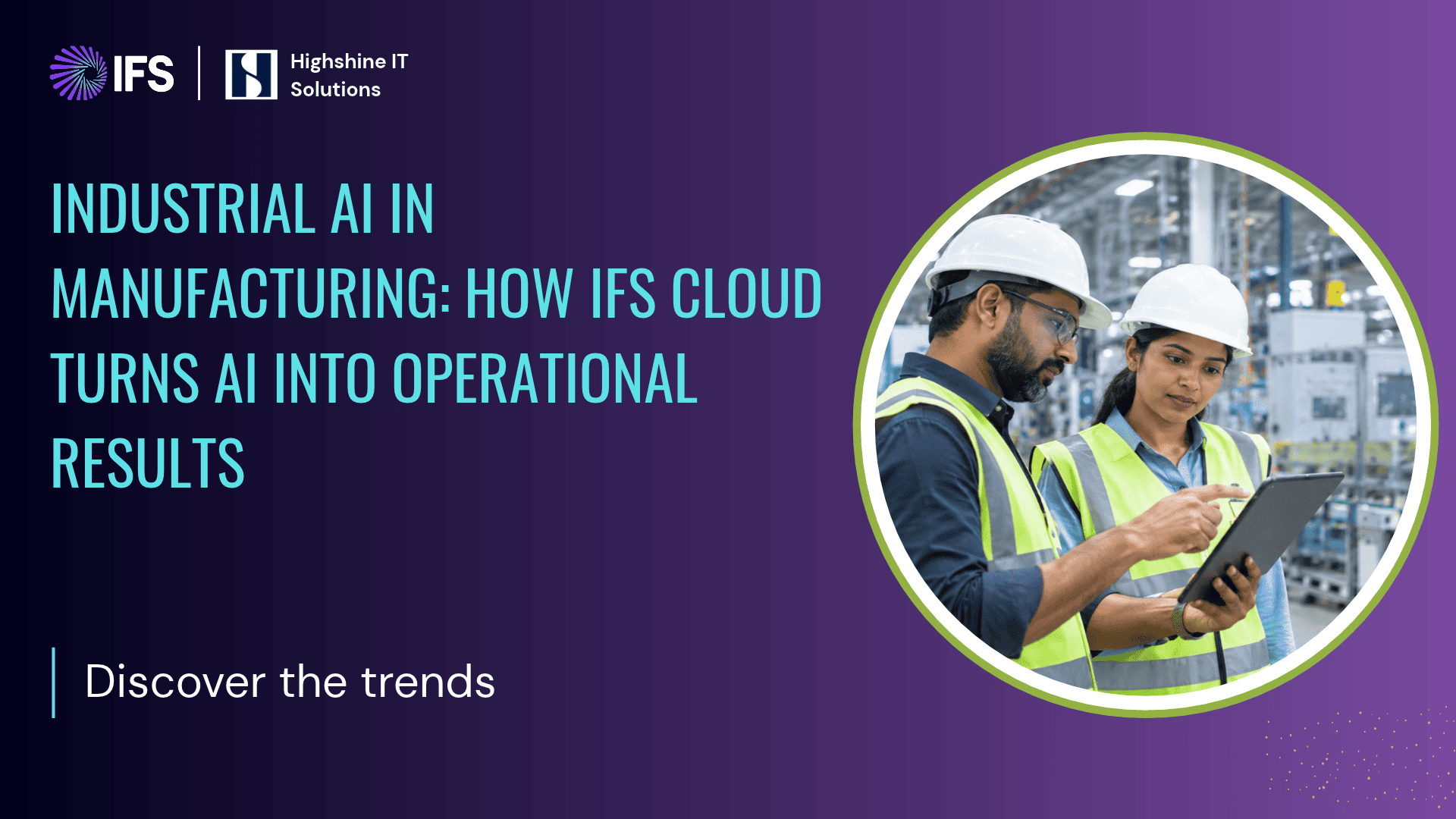
Most conversations about AI in manufacturing start with what AI can theoretically do. Better demand forecasting. Predictive maintenance. Autonomous scheduling. Supply chain optimization. The list is familiar because it has been on vendor roadmaps for years. What has changed in 2025 and 2026 is not the promise. It is evidence that the promise is being delivered in production by manufacturers who chose the right platform to build on.
IFS Cloud is that platform for a growing number of the world's most complex manufacturers. Not because it has the most AI features on a slide deck, but because its industrial AI capabilities, built across three distinct layers, are embedded into the operational workflows where manufacturers actually make decisions: production scheduling, asset maintenance, supply chain coordination, and frontline technician support. This blog explains the difference between AI as a marketing concept and AI in manufacturing as an operational reality, and specifically how IFS delivers the latter.
For a decade, the manufacturing industry has been told AI will transform operations. For most manufacturers, that transformation has not arrived in the form they expected. Point solutions that require data science teams to operate. AI dashboards that generate recommendations nobody acts on because they are disconnected from the systems people use to actually do their work. Proof-of-concept pilots that never reach production.
The Manufacturers' AI Adoption Playbook, published by IFS, identifies the core reason for this gap: most industrial AI tools generate insights but do not help manufacturers take action. The insight that a machine is likely to fail in the next 48 hours is only valuable if the maintenance work order is raised, the right technician is dispatched, and the right parts are confirmed available, automatically, within the same system that generated the prediction. When the AI is layered on top of the ERP rather than embedded within it, that chain of action breaks, and the insight becomes a report that someone has to act on manually.
IFS's approach is to embed AI into the operational flow of the platform itself, so that intelligent recommendations translate directly into actions without requiring a separate step, a separate system, or a separate team.
IFS describes its industrial AI architecture as three distinct but connected layers, each addressing a different level of manufacturing intelligence. Understanding these three layers is important because it explains why IFS's approach to AI in manufacturing software is structurally different from vendors who have added AI features to an existing ERP.
| Layer | What It Does | Manufacturing Impact |
| IFS.ai / Industrial Intelligence | Embedded AI across IFS Cloud: demand sensing, scheduling optimization, anomaly detection, quality prediction | Faster decisions in planning, production, and asset management without leaving the ERP |
| IFS Loops Digital Workers | Agentic AI workers that execute end-to-end workflows autonomously. 60% of agentic transactions fully automated | Supplier coordination, order management, field dispatch, and routine coordination run without human intervention |
| IFS Nexus Black | AI innovation accelerator co-created with operators. Moves from prototype to production in days, not months | Solves specific high-value manufacturing problems that standard systems cannot address out of the box |
These three layers are not separate products that need to be integrated. They are components of the same platform, operating on the same data model, within the same IFS Cloud environment where production, maintenance, supply chain, and finance already run.
IFS.ai is the AI capability embedded directly across IFS Cloud, covering demand sensing and forecasting, production scheduling optimization, quality prediction, anomaly detection in asset performance, and AI-assisted supply chain planning. The distinguishing characteristic is not the sophistication of the models. It is where the output lands.
When IFS.ai detects that demand for a product is trending above forecast, that signal flows directly into the production scheduling module. When it identifies an anomaly in an asset's operating data, it generates a maintenance work order within the same system that manages the maintenance team's schedule and the spare parts inventory. The recommendation does not arrive in a separate analytics tool waiting for a human to bridge the gap. It arrives as an action inside the system where that action can be taken.
Harwin PLC, an electronics manufacturer, describes the impact directly: IFS has given us instant access to live actionable data, which we have used to control our business for the last three to four years. The company has experienced 20% year-on-year growth and attributes the ability to maintain that trajectory to the operational intelligence IFS provides. Cheer Pack North America, a flexible packaging manufacturer, used IFS.ai to switch to a shop-order system that allows far greater traceability, giving the company the ability to meet all customer needs that were previously difficult to fulfill reliably.
IFS Loops represents a more significant shift in what AI in manufacturing can mean operationally. Launched in November 2025 and acquired as TheLoops earlier in the year, the Loops Agentic Platform deploys Digital Workers, AI agents that do not just recommend actions but execute them end to end across workflows that previously required human coordination at every step.
In manufacturing, these Digital Workers handle tasks like supplier coordination when a supply disruption is detected, customer order management when demand patterns change, field dispatch for maintenance technicians, and routine workflow coordination that consumes significant operational capacity when done manually. By H1 2026, 60% of agentic transactions on the IFS Loops platform were running fully automated. The platform demonstrated the potential to unlock up to 10x workforce capacity in early deployments.
The design principle behind Loops is worth understanding because it addresses a real concern in industrial environments: AI should prepare and execute work, but people should remain accountable for decisions that affect customers or safety. Loops Digital Workers gather context, prepare the next step, and trigger work where the rules permit. Exceptions, approvals, and consequential decisions route to the right human. The system carries the routine coordination. People handle what genuinely requires human judgment.
This is not automation as job replacement. It is automation as capacity expansion, giving manufacturing operations teams the ability to manage significantly higher complexity without proportional headcount growth.
Nexus Black is IFS's AI innovation accelerator, designed for manufacturing problems that are too specific, too complex, or too high-value to be addressed by generalized platform features. Where IFS.ai covers the intelligence embedded in standard workflows and Loops covers autonomous workflow execution, Nexus Black co-creates purpose-built AI capabilities with the manufacturers who face specific operational challenges.
The most documented capability from Nexus Black is Resolve, developed in partnership with Anthropic and built on Claude. Resolve places AI directly in the hands of frontline technicians and field workers, giving them access to context-aware guidance that breaks complex maintenance procedures, equipment documentation, and specialized expertise into clear, actionable steps at the point of work. William Grant and Sons, the Scottish whisky maker, uses Resolve at its distillery to help technicians identify hazards and equipment issues that humans might otherwise miss. IFS has also deployed Resolve at an airport hangar in the Middle East for aircraft maintenance technicians.
For manufacturing specifically, Resolve addresses one of the most persistent and underacknowledged operational problems: the concentration of critical maintenance knowledge in a small number of experienced technicians. When that knowledge lives in people's heads rather than in a system, it is vulnerable to attrition, unavailable across shifts, and impossible to scale. Nexus Black's Resolve makes it accessible, consistently, at the moment it is needed.
Nexus Black operates on a different timeline to traditional enterprise software development. Where a standard ERP feature request might take twelve to eighteen months to reach production, Nexus Black moves from customer challenge to productized innovation in weeks, and from prototype to production deployment in days.
IFS Cloud's industrial AI capabilities are not equally valuable in every manufacturing environment. They deliver the most measurable impact in environments where operational complexity is high, and the cost of poor decisions or missed signals is significant.
Aerospace and defense, automotive, machinery and industrial equipment manufacturers deal with engineer-to-order complexity, long supply chains, and precision quality requirements. IFS.ai's demand sensing and scheduling optimization directly reduce the lead time variance and capacity utilization inefficiency that cost these manufacturers margin. Nexus Black's Resolve supports the highly specialized maintenance knowledge required for complex assemblies and precision equipment.
Food and beverage, chemicals, life sciences, and metals manufacturers need consistent quality, predictable asset performance, and tight regulatory compliance. IFS.ai's anomaly detection and predictive maintenance capabilities reduce unplanned downtime on critical production assets, while AI-driven quality prediction catches deviations before they become non-conformances. IFS Zero, launched in 2026, cuts emissions data collection effort by up to 30%, addressing the sustainability reporting requirements that process manufacturers face across multiple regulatory frameworks.
Manufacturers with large production asset portfolios, particularly in minerals, metals, wood and paper, and industrial equipment, benefit most from the connection between IFS.ai's condition monitoring and the EAM module's maintenance scheduling. The 2026 IDC MarketScape recognized IFS as a Leader in Worldwide Manufacturing AI-Enabled Asset-Intensive EAM Applications, specifically for this combination of manufacturing and asset management intelligence.
The case for IFS as the leading platform for AI in manufacturing rests on more than product claims. The evidence is accumulating across customer outcomes, analyst recognition, and IFS's own financial performance.
IFS delivered 25% ARR growth in H1 2026 and 23% for FY2025, driven by the scaling of Industrial AI across manufacturing, maintenance, supply chain, and field service. This is the commercial evidence that manufacturers are choosing IFS specifically for its AI capabilities, not as a secondary consideration.
Forrester's Total Economic Impact study of IFS Cloud, commissioned by IFS, found measurable returns across operational efficiency, asset utilization, and time to market for manufacturers who deployed the platform. The IFS manufacturing page cites percentage improvements across faster time to market, operational efficiency, asset utilization, and maintenance cost reduction.
IFS was named a Leader in the 2026 IDC MarketScape for Worldwide Manufacturing AI-Enabled Asset-Intensive EAM Applications, recognized specifically for combining manufacturing execution intelligence with asset management AI.
IFS is the only company named Customers' Choice in the 2026 Gartner Peer Insights Voice of the Customer for Cloud ERP for Product-Centric Enterprises, reflecting the experience of manufacturing customers who have deployed the platform and chosen to publicly endorse it.
IFS won ERP Today's AI and Innovation of the Year award for IFS.ai, with judges recognizing the platform for embedding intelligence directly into the core ERP rather than layering it on top.
Partnerships with Anthropic for Nexus Black Resolve, Siemens, AVEVA, and NEC for operational intelligence, and MIT CISR for research, reflect the breadth of the Industrial AI ecosystem IFS is building around its manufacturing platform.
Realizing the operational value of IFS Industrial AI in manufacturing requires an implementation partner who understands both the platform architecture and the specific workflows, asset types, and decision patterns that make AI recommendations actionable in a given production environment.
Highshine IT Solutions is a specialist IFS implementation partner with manufacturing deployment experience across discrete, process, and asset-intensive production environments. The team configures IFS Cloud, IFS.ai, and the relevant Loops and Nexus Black capabilities around the manufacturer's specific operations, data environment, and operational priorities. Implementation covers process mapping, platform configuration, data integration, AI model tuning to the specific manufacturing context, user training, and post-go-live support.
Book a free IFS Cloud consultation with Highshine IT Solutions. Get a platform walkthrough that shows industrial AI in manufacturing in the context of your specific production environment, and a clear view of how IFS.ai, Loops, and Nexus Black map to your operational challenges.
AI in manufacturing has been a promise for a long time. In 2025 and 2026, it has become, for the manufacturers who chose the right platform, an operational reality. The difference between AI that generates insights and AI that drives results is whether the intelligence is embedded in the systems where operational decisions are made, or separated from them by a layer of manual interpretation and action.
IFS Cloud's three-layer industrial AI architecture- IFS.ai embedded in operational workflows, IFS Loops Digital Workers executing autonomous agentic processes, and IFS Nexus Black solving specific high-value manufacturing problems in weeks- represents the most integrated and validated approach to manufacturing AI software available in 2026. For manufacturers ready to move from AI experimentation to AI execution, IFS Cloud is the platform that closes the gap between what industrial AI can do and what it demonstrably delivers.
Industrial AI in manufacturing refers to artificial intelligence capabilities that are embedded into the operational systems manufacturers use to plan, produce, maintain assets, and coordinate supply chains, rather than existing as standalone analytics tools. The defining characteristic of industrial AI is that it drives action within operational workflows, not just recommendations in a separate dashboard. IFS Cloud embeds industrial AI across ERP, MES, EAM, and supply chain functions through IFS.ai, IFS Loops Digital Workers, and IFS Nexus Black.
IFS.ai is embedded directly within IFS Cloud rather than sitting alongside it as a separate application. When IFS.ai detects a demand spike, the signal flows into the production scheduling module. When it identifies an asset anomaly, it generates a maintenance work order within the same system that manages technician scheduling and spare parts inventory. Generic AI tools generate recommendations that require a human to bridge the gap between insight and action. IFS.ai operates within the system where the action is taken, eliminating that gap.
IFS Loops Digital Workers are AI agents that execute end-to-end operational workflows autonomously rather than simply making recommendations for humans to act on. In manufacturing, they handle tasks like supplier coordination during disruptions, customer order management when demand patterns shift, and routine workflow coordination that previously required manual effort at every step. By H1 2026, 60% of agentic transactions on the Loops platform were fully automated. The design principle is that Digital Workers handle routine coordination while humans remain accountable for decisions that affect customers or safety.
IFS Nexus Black is IFS's AI innovation accelerator that co-creates purpose-built AI capabilities with manufacturers to solve specific operational problems that standard platform features cannot address. The most deployed capability is Resolve, built in partnership with Anthropic, which gives frontline technicians access to AI-assisted guidance at the point of work, breaking complex maintenance procedures and specialized knowledge into clear, actionable steps. William Grant and Sons uses Resolve at its Scottish distillery. The platform moves from prototype to production deployment in days rather than months.
IFS industrial AI delivers the most measurable impact in environments where operational complexity is high and the cost of poor decisions is significant. Discrete and complex manufacturers in aerospace, automotive, and industrial equipment benefit most from IFS.ai's scheduling optimization and Nexus Black's specialized maintenance support. Process manufacturers in food, chemicals, and life sciences gain most from predictive quality and asset anomaly detection. Asset-intensive manufacturers benefit from the connection between condition monitoring and EAM maintenance scheduling, the combination recognized by IDC's 2026 MarketScape for Manufacturing AI-Enabled Asset-Intensive EAM.
IFS was named a Leader in the 2026 IDC MarketScape for Worldwide Manufacturing AI-Enabled Asset-Intensive EAM Applications. IFS is the only vendor named Customers' Choice in the 2026 Gartner Peer Insights Voice of the Customer for Cloud ERP for Product-Centric Enterprises. IFS won ERP Today's AI and Innovation of the Year award for IFS.ai. IFS delivered 25% ARR growth in H1 2026, driven by the scaling adoption of Industrial AI across manufacturing customers globally.
IFS Zero is a capability within IFS Cloud that reduces the effort required to collect, validate, and report Scope 1, 2, and 3 emissions data. IFS reports that IFS Zero cuts emissions data collection effort by up to 30%. For manufacturers facing mandatory sustainability reporting requirements across multiple regulatory frameworks, this integration between operational data and emissions tracking removes the manual data aggregation that makes sustainability reporting both slow and difficult to audit.