 Surendar subramani
 17/04/2026
 IFS
IFS 0 Comments
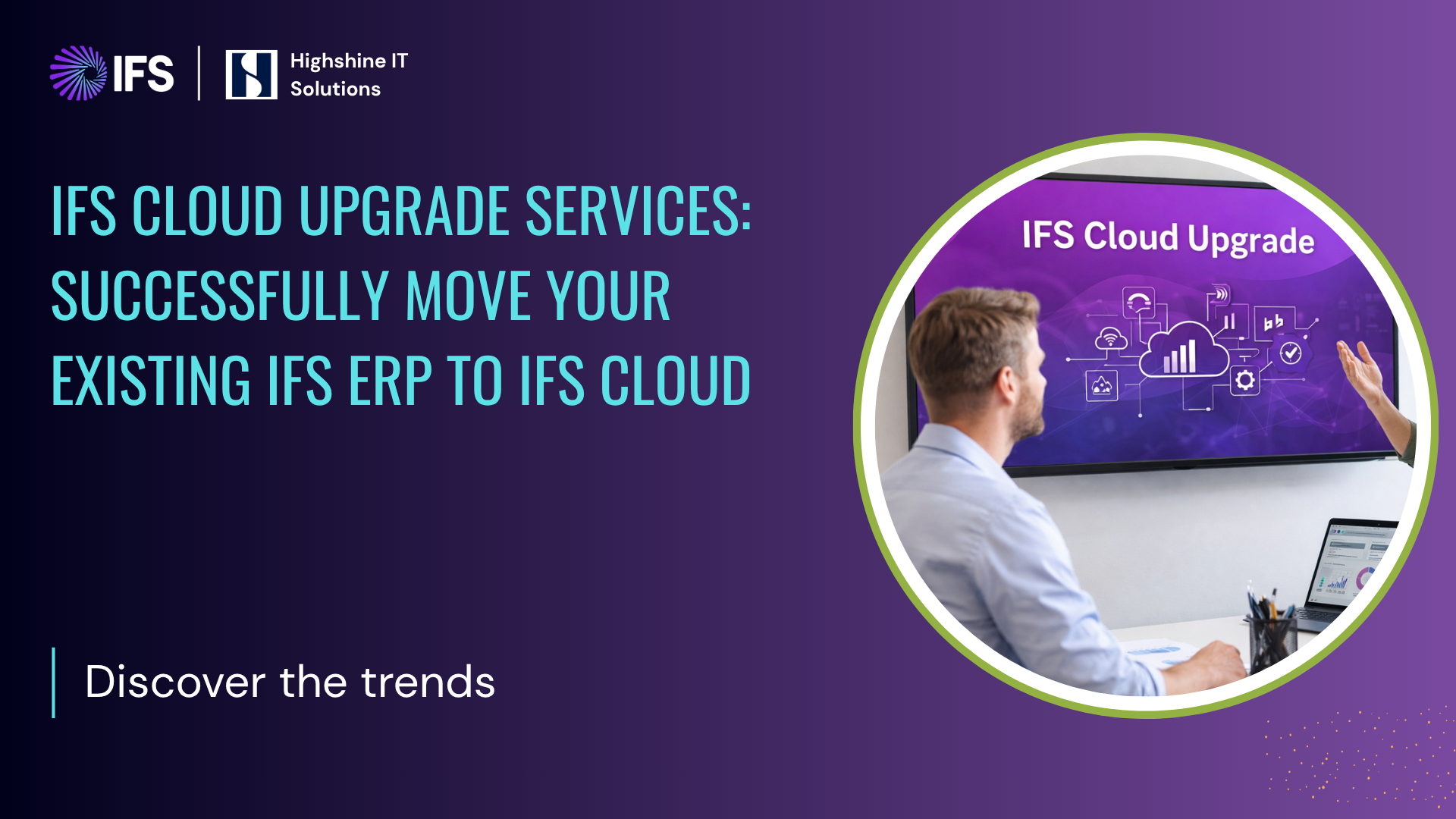
IFS Cloud Upgrade Services: Successfully Move Your Existing IFS ERP to IFS Cloud
If your business is still running IFS Applications 9 or 10, you're not alone, but the clock is ticking. IFS has made IFS Cloud its primary platform, and the gap between legacy versions and the cloud is growing wider every release cycle. An IFS Cloud upgrade is no longer a future consideration; for most organizations, it's a present-day business priority.
This guide walks you through everything you need to know, from why the move matters to what actually changes, to how a structured upgrade project unfolds. Whether you're just beginning to evaluate the decision or already building your business case, this is your starting point.
Why Businesses Are Upgrading to IFS Cloud
IFS has shifted its entire product investment toward IFS Cloud. What that means in practice is that new features embedded AI, advanced IoT integrations, machine learning-powered analytics, and continuous UX improvements are being built exclusively for the cloud version. Organizations still on legacy IFS versions receive security patches and bug fixes, but the innovation pipeline has firmly moved on.
There is also the question of support lifecycles. IFS has communicated clear timelines for winding down extended support on older versions. Businesses that delay the IFS Cloud upgradation process risk running ERP infrastructure that is increasingly costly to maintain, harder to integrate with modern systems, and ineligible for new functionality that competitors are already using.
The "Evergreen" Advantage
One of the most meaningful changes IFS Cloud introduces is the shift away from large, infrequent upgrades. Instead of a major version leap every five to seven years, IFS Cloud delivers two major releases annually with smaller continuous updates in between. You stay current automatically, no more multi-year projects just to catch up.
The Real Cost of Staying on Legacy IFS
This is a conversation most IT leaders and CFOs eventually have to sit down for, and it rarely goes the way people expect. On the surface, staying on IFS Applications 9 or 10 appears to be the safe, budget-friendly choice. You've already paid for it. Your team knows it. Nothing is broken, at least not visibly.
But the costs of staying put tend to accumulate quietly. Every year you remain on a legacy version, your internal IT team spends more time keeping the lights on and less time driving value. Customizations that once solved real problems become technical debt. Integration with newer third-party tools becomes more complex. And when something does break, you're dealing with a smaller and smaller pool of consultants who know the older version well enough to fix it quickly.
There's also the opportunity cost of the capabilities your business simply isn't using. Predictive maintenance, AI-assisted scheduling, and real-time operational analytics aren't distant future features. Competitors running IFS Cloud are using it now. Every quarter you delay is a quarter they pull further ahead in operational efficiency.
The business case for upgrading to IFS Cloud isn't just about new features. It's about stopping the slow drain of resources that legacy environments demand, and reinvesting that capacity in things that actually move the business forward.
IFS Cloud vs. Legacy IFS Versions: What Actually Changes
Understanding what you're moving toward is just as important as understanding what you're leaving behind. The differences between IFS Applications 10 and IFS Cloud go well beyond a new interface.
Legacy IFS Applications: On-premise or hosted. Major upgrades every 5–7 years. Heavy internal IT overhead for maintenance. Limited mobile and remote access. Rigid customizations that break on upgrade. No embedded AI or ML capabilities. Siloed communication outside the ERP.
IFS Cloud: Evergreen cloud platform. Continuous updates, twice-yearly major releases. Infrastructure managed by IFS or a partner. Full mobile access on any device. Configuration-based extensions that are upgrade-safe. Embedded AI, IoT, and predictive analytics. In-system collaboration and Team integration.
When you upgrade IFS 10 to the cloud, you're not just moving data to a new server. You're shifting to a fundamentally different operating model, one where your ERP evolves alongside your business rather than falling behind it.
Key Benefits of Moving to IFS Cloud
The business case for an IFS Cloud upgrade rests on both immediate and long-term returns. Here's what organizations consistently gain after making the transition.
Built-in AI & Automation: IFS Cloud integrates AI and automation across areas such as predictive maintenance, service scheduling optimization, and operational analytics. Built-in machine learning helps organizations gain insights from asset performance, procurement patterns, and operational data without relying heavily on third-party add-ons.
Real-Time Visibility: Power BI integration and live dashboards give finance, operations, and leadership teams instant access to accurate, cross-departmental data.
Enterprise-Grade Security: End-to-end encryption, role-based access controls, continuous threat monitoring, and ISO-aligned security protocols protect sensitive business data.
Scalability & Global Reach: Multi-currency, multi-language, and multi-entity support in a single environment makes expansion to new regions or business units significantly simpler.
Mobile-First Workforce: Field technicians, traveling managers, and remote teams get full ERP access from any device without VPNs or complex remote desktop setups.
Reduced IT Costs: Hardware, server maintenance, and legacy support contracts represent significant ongoing spend. IFS Cloud shifts these costs to a predictable subscription model.
Security Features That Help You Stay Compliant
For industries operating under strict regulatory frameworks, whether that's ISO 27001, SOC 2, GDPR, DPDP in India, HIPAA in healthcare, or defense-related standards like ITAR and CMMC, the question of compliance isn't a box to tick during implementation. It's something your ERP needs to actively support every single day.
This is one area where the gap between legacy IFS and IFS Cloud is especially significant.
On older IFS versions, compliance often required custom-built solutions, manual audit processes, and third-party security tools stitched together around the ERP. It worked, but it was fragile. Any upgrade, patch, or configuration change could disrupt those controls, and keeping audit trails complete required constant attention from someone who understood both the system and the regulatory requirements.
IFS Cloud takes a fundamentally different approach by building compliance-relevant security features directly into the platform.
Role-based access control (RBAC) in IFS Cloud is granular enough to satisfy most regulatory requirements around data separation and least-privilege access. You can define exactly who sees what, down to the field level, and those permissions move with the user across every IFS Cloud module, no gaps, no workarounds.
Audit logging is comprehensive and tamper-evident. Every action taken in the system that accessed what data, when, what was changed, and from which device is captured automatically. When regulators ask for evidence of access controls or data handling practices, that trail is already there.
Data residency and sovereignty controls matter increasingly to organizations operating across multiple countries. IFS Cloud allows you to define where your data lives and how it's handled, which is directly relevant to compliance with GDPR in the EU, DPDP in India, and similar frameworks in the Middle East and UK markets.
Encryption at rest and in transit is standard and managed by IFS, removing the risk of misconfigured or outdated encryption that often surfaces in on-premise ERP audits. Penetration testing, vulnerability management, and infrastructure hardening are handled continuously, not just during a quarterly review cycle.
For organizations in regulated industries, manufacturing, defense supply chain, asset-intensive energy businesses, or healthcare, this built-in compliance posture is often one of the strongest arguments for making the move. It shifts your team's energy from maintaining compliance infrastructure to actually running the business within a system that's designed to support those standards from the ground up.
How the IFS Cloud Upgrade Process Works
A well-executed IFS Cloud upgradation project follows a structured path. While every organization's situation is different, the core phases remain consistent. Rushing any of them introduces risk; respecting each one protects your go-live date and your data.

Common Challenges and How to Address Them
No ERP upgrade is without friction. The organizations that navigate the IFS Cloud upgrade most successfully are those that anticipate challenges rather than react to them.
The most frequent issue is legacy customizations. Businesses that heavily modified their IFS Applications environment over the years often discover that those customizations either don't translate to cloud-native configuration or need significant redesign. The solution is not to blindly replicate old customizations, but to ask whether the underlying business need is still valid and whether IFS Cloud's standard functionality now covers it.
Change resistance is the second major challenge. Users who have worked with a familiar system for years naturally resist a new interface and new workflows. Early involvement of key users in the testing phase, transparent communication about what is changing and why, and practical training tied to real job tasks all meaningfully reduce this friction.
Data migration complexity is often underestimated. Years of accumulated data, some of it incomplete or inconsistently formatted, can slow a migration significantly. Investing proper time in the data cleansing phase before migration begins is almost always worth it.
"It's better to get on board with the current system, start working with it, and be part of its evolution rather than wait for the perfect moment that never comes."
Why Choose Highshine IT Solutions for Your IFS Cloud Upgrade
Choosing the right implementation partner is just as important as choosing the right platform. Highshine IT Solutions is a specialized ERP firm with deep, hands-on expertise in IFS serving clients across India, the UK, the USA, the Middle East, and the EU. As an official IFS Services Partner, we support the giants like Tech Mahindra and Wipro. Highshine brings both certified competency and real-world delivery experience to every IFS Cloud upgrade engagement.

Highshine Expertise
Highshine covers the full IFS lifecycle from the initial consultation and gap analysis right through to post-go-live support. Their IFS service offerings include version upgrades, fresh implementations, deep customization, data migration, system integration, and ongoing L1/L2/L3 support. For organizations undertaking IFS Cloud upgradation, Highshine's structured approach ensures that legacy configurations are mapped cleanly to cloud-native equivalents, that data migration is handled without loss or disruption, and that users are trained and confident before go-live.
Their team includes Senior IFS Functional Consultants, IFS Technical Consultants, and IFS Developers, with global project delivery capability. Every engagement begins with a thorough assessment of the client's existing IFS environment, followed by a tailored roadmap that fits the organization's timeline, budget, and operational priorities.
Experience That Matters on Upgrade Projects
What sets Highshine apart in upgrade engagements specifically is their version-spanning experience. Their team has worked across IFS Applications 8, 9, 10, Aurena, and IFS Cloud, which means they understand what breaks between versions, where the upgrade risks typically surface, and how to design a migration path that minimizes business disruption. They are currently actively engaged in upgrading an Indian automobile manufacturer from IFS Apps 9 to IFS Cloud 25R1, giving them live, current knowledge of the upgrade process in practice. Highshine is a partner equipped to guide the entire journey from the first assessment call to the day your teams go live on the cloud.
Talk to our expert about your IFS Cloud upgrade. Our team will assess your current environment, outline a clear path forward, and ensure your transition is smooth, on time, and built to last.