


 Surendar subramani
 09/04/2026
 IFS
IFS 0 Comments
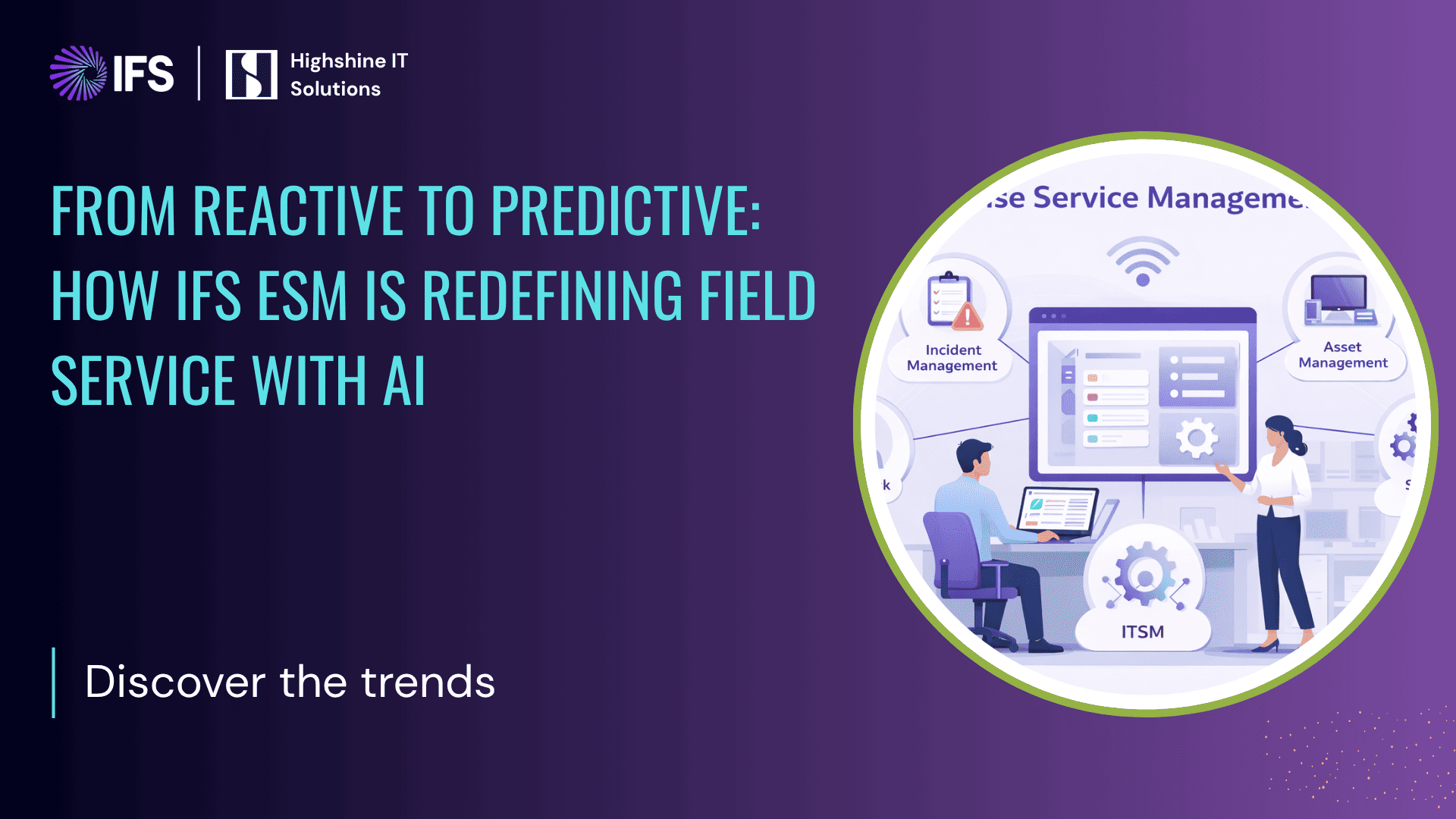
From Reactive to Predictive: How IFS ESM is Redefining Field Service with AI
For industries running on physical assets, downtime is not just an inconvenience; it is lost revenue, missed SLAs, and frustrated customers. Here is how IFS Enterprise Service Management is helping operations teams finally get ahead of the problem.
A critical piece of equipment fails on the floor of a manufacturing plant. A technician gets dispatched, but they don't have the right part. A second visit is scheduled. More downtime. More cost. Another unhappy customer. Sound familiar? If it does, your operation is still running on a reactive model, and you are not alone. The majority of asset-heavy industries still manage service this way. Problems get fixed after they happen, not before.
But that model is getting harder to justify. Customers expect faster resolutions. Budgets are tighter. And the sheer volume of assets to manage keeps growing. Something has to change.
That is exactly the space IFS Enterprise Service Management (IFS ESM) was built for. It is a field service management platform designed to help organizations move from chasing problems to preventing them using AI, real-time data, and a deep understanding of how assets actually behave in the field.
What is IFS Enterprise Service Management?
IFS ESM is an enterprise-grade service management platform built specifically for organizations that run large-scale field operations and manage complex physical assets. We are talking about power grids, industrial machinery, telecom networks, HVAC systems, and similar infrastructure, where keeping things running is non-negotiable. What makes it different from the generic tools out there? Most service platforms are built around tickets. A problem comes in, a ticket is created, and someone gets sent. The asset itself is almost a footnote.
IFS ESM takes a completely different approach. It is built around two core principles: AI-driven intelligence and asset-centric service management. Every decision the platform helps you make, from scheduling a technician to flagging a part that needs replacing, is grounded in data, not guesswork. It also connects seamlessly with IFS Cloud EAM (Enterprise Asset Management), IFS ERP, and field execution tools, so your service teams, finance, and operations are all working from the same picture.
How AI-Driven Field Service Management Actually Works
AI in field service management is not about replacing your technicians. It is about making sure they show up to every job with the right information, the right parts, and a clear plan.
Here is how IFS ESM puts AI to work across your service operation:
Predictive Maintenance Software Built In: Instead of waiting for equipment to fail, IFS ESM analyzes IoT sensor data, historical maintenance records, and real-world usage patterns to predict failures before they happen. You get an alert, you schedule the work, and your customer never even knows there was a risk. That shift from reactive to predictive maintenance is one of the biggest operational wins organizations report after implementing IFS ESM.
Intelligent Scheduling and Dispatch: Matching the right technician to the right job used to mean a lot of manual effort, checking availability, skills, location, and job priority. IFS ESM automates all of it. Its AI-driven scheduling optimization assigns the best person to each job in seconds, reducing travel time and maximizing the chances of a first-time fix.
Work Order Automation: Repetitive tasks like creating work orders, triggering parts requests, sending SLA alerts, and updating records are handled automatically. Your team spends less time on admin and more time on work that actually requires human judgment.
Real-Time Visibility for Managers: Operations managers get a live view of everything happening in the field: who is where, what is in progress, what is at risk. When something goes off track, they can act on facts, not assumptions.
The downstream effects of getting this right are significant. Organizations using AI-driven field service management consistently report higher equipment uptime, better first-time fix rates, and meaningful reductions in cost-to-serve.
What 'Asset-Centric' Really Means and Why It Matters
This is the part that tends to surprise people when they first look at IFS ESM.
Most field service management platforms organize work around jobs and tickets. IFS ESM organizes everything around the asset. Every service interaction, every work order, every technician visit, every part replaced is tied back to a specific asset and its full lifecycle history.
When a technician is dispatched to a job, they do not just know what broke. Through the mobile field execution tools connected to IFS ESM, they can see the complete asset profile: installation date, previous repairs, warranty status, known failure patterns, recommended parts, and even what is likely to fail next. This is what true asset-centric service management looks like, and it is a very different experience from arriving on site with nothing but a work order reference number.
For organizations managing thousands of assets across multiple sites, this lifecycle visibility is transformational. You move from managing reactive incidents to managing the health of your entire asset base, which changes the economics of service entirely.
Which Industries Can Benefit from IFS ESM?
IFS ESM is purpose-built for industries where assets are central to operations, and the cost of failure is high. If your business depends on physical infrastructure staying operational, this platform was designed with your challenges in mind.
Manufacturing and Industrial: Keep production lines running through proactive maintenance, intelligent scheduling, and full asset lifecycle visibility. IFS ESM for manufacturing helps reduce costly unplanned shutdowns and improve overall equipment effectiveness (OEE).
Utilities and Energy: Manage vast infrastructure networks across multiple regions with predictive maintenance software that flags risks before they become outages. IFS ESM for utilities is already being used to coordinate large field workforces and support compliance requirements.
Telecom and IT Infrastructure: Coordinate large teams of field technicians with AI-driven scheduling, real-time tracking, and work order automation, ensuring installations and repairs are completed on time.
Facilities and Property Management: Get a single view of asset health across every site you manage, with automated maintenance workflows and SLA tracking built in.
Aerospace and Defense: Meet strict compliance requirements and manage mission-critical assets with an audit-ready platform that documents every action taken.
Oil, Gas, and Resources: Handle the complexity of remote operations, hazardous environments, and regulatory demands with a platform built for asset-intensive field work.
The Business Case: What Does the Shift Actually Deliver?
Moving from a reactive service model to a predictive, asset-centric one is not just an operational improvement; it has a direct and measurable impact on the bottom line.
Organizations that have implemented IFS ESM and connected it with AI-driven field service management report results like:
Up to 20% improvement in equipment uptime
33% gains in technician productivity
35% reduction in drive time through intelligent scheduling
Higher first-time fix rates, reducing costly repeat visits
Significant reduction in unplanned downtime across asset portfolios
Beyond the numbers, there is a strategic shift that happens when your service operation becomes predictive. You stop being the team that fixes things and start being the team that prevents problems. That is a very different conversation to have with your customers, and it builds a much stronger relationship.
There is also a competitive angle here. The global field service management market is projected to grow from $5.1 billion in 2025 to $9.17 billion by 2030. Organizations that build modern, AI-driven service capabilities now will be significantly better positioned as that market matures.
IFS ESM vs Traditional ITSM: The Real Difference
A common question from IT decision makers evaluating platforms is: how does IFS ESM compare to tools like ServiceNow or Salesforce Field Service?
The honest answer is that they are built for different problems. Platforms like ServiceNow excel at IT service management and internal helpdesk workflows. Salesforce Field Service does a good job for sales-driven service environments. But neither was built from the ground up for asset-intensive field operations at enterprise scale.
IFS ESM is different because:
It is natively connected to IFS Cloud EAM and ERP, so asset data, financial data, and service data are not siloed.
Its field service optimization is built for high-complexity environments, large workforces, multiple skills, and complex SLA structures.
Its predictive maintenance software is purpose-built for industrial asset failure patterns, not just IT incidents.
It supports outcome-based service models, helping organizations shift toward long-term service contracts and uptime guarantees.
For organizations in asset-heavy industries evaluating their field service management platform, this operational depth is what often tips the decision.
Is Your Organization Ready for Predictive Service Management?
Here is a simple way to assess where you are today. If any of these sound familiar, your current setup may be holding you back:
Your team finds out about asset failures after customers report them.
Scheduling is still handled manually or through spreadsheets.
Technicians regularly arrive on site without the right parts or information.
Your asset data lives in multiple disconnected systems.
You cannot accurately predict your maintenance costs six months out.
If two or more of those apply, moving to an AI-driven, asset-centric service management platform like IFS ESM is not just an upgrade; it is a necessary step for staying competitive.
Frequently Asked Questions:
1. What is IFS Enterprise Service Management (IFS ESM)?
IFS ESM is an enterprise service management platform that unifies IT and business service delivery on a single system. It extends beyond traditional IT helpdesk tools to cover field operations, asset management, HR service delivery, and finance, making it particularly well-suited for large, asset-heavy organizations that need service management across departments, not just the IT team.
2. What is the difference between IFS ESM and IFS Cloud Service Management?
IFS ESM focuses on enterprise-wide service management, extending service principles across all departments of an organization. IFS Cloud Service Management, on the other hand, is the field service and customer service layer built natively inside IFS Cloud. Both work together: ESM handles internal workflows and requests, while IFS Cloud manages external, customer-facing service delivery and field operations.
3. Which industries benefit most from IFS ESM?
Industries with complex field operations and large asset portfolios see the greatest benefit. This includes manufacturing, utilities and energy, telecom, oil and gas, aerospace and defense, and facilities management. Essentially, if your business runs on physical assets and your service teams operate in the field, IFS ESM is built for you.
4. How does IFS ESM use AI for predictive maintenance?
IFS ESM connects with IoT sensors and real-time asset data to monitor equipment health continuously. Using machine learning models, it analyzes historical failure patterns, usage trends, and sensor readings to flag assets that are likely to fail before they do. Maintenance can then be scheduled proactively, avoiding the unplanned downtime that costs asset-heavy businesses significant time and money.
5. What does 'asset-centric service management' mean in practice?
It means every service interaction is organized around the asset, not just the job ticket. In IFS ESM, each asset has a full history of installations, repairs, part replacements, warranty records, and performance trends. When a technician is dispatched, they have complete context about that specific asset, which significantly improves first-time fix rates and reduces repeat visits.
6. How is IFS ESM different from ServiceNow or Salesforce Field Service?
The main difference is depth of focus. ServiceNow is primarily built for IT service management. Salesforce Field Service is built around CRM-driven service. IFS ESM is built for organizations managing complex physical assets and large field workforces with native connections to IFS Cloud EAM and ERP that other platforms cannot match out of the box.
7. What is the ROI of implementing IFS ESM?
ROI varies by organization, but reported outcomes from IFS customers include 20% improvement in equipment uptime, 33% gains in technician productivity, and a 35% reduction in drive time. First-time fix rates improve when technicians arrive with the right information and parts, cutting costly repeat visits. The bigger long-term value comes from the shift to predictive operations, fewer emergency responses, lower maintenance costs, and stronger customer relationships.
Ready to Move Beyond Reactive?
If your service operation is still running on spreadsheets, siloed systems, or gut feel, IFS ESM is worth a serious look. It brings together AI-driven field service management, asset-centric service management, and enterprise-wide service delivery in one platform built for the complexity of real operations.
The question is not whether your industry needs a smarter field service management platform. The question is how much longer you can afford to wait.
Want to see how IFS ESM could work for your operation? Get in touch with our team; we'd love to walk you through it.


