Loading Experience...
Fill out the form and our experts will connect with you shortly to understand your business requirements.
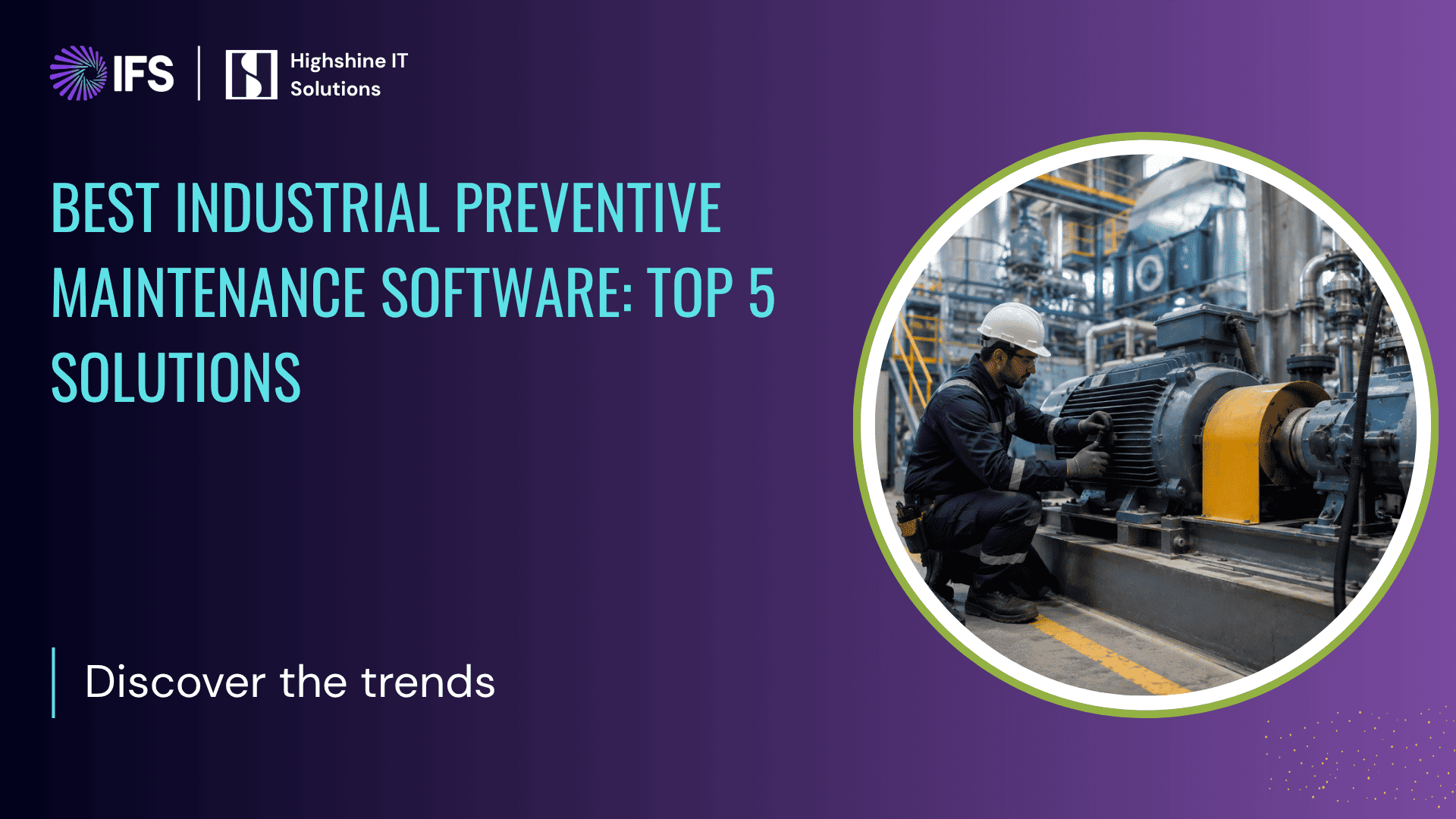
Unplanned equipment downtime is not just an operational inconvenience. In industrial environments, it is a costly event that triggers a cascade: production halts, maintenance teams scramble, spare parts get expedited at premium cost, and delivery commitments get missed. The businesses that consistently avoid this cycle are not the ones with the best technicians. They are the ones with the right industrial preventive maintenance software running the right process.
Preventive maintenance software gives maintenance teams the structure to schedule, execute, and record planned maintenance before failures occur, turning what would have been an emergency into a routine task. But not all platforms are built for the same environment. A tool that works well for a single facility managing 200 assets performs very differently from one running maintenance across five plants with thousands of assets, multiple compliance frameworks, and integrations with ERP and supply chain systems.
This guide compares the top five industrial preventive maintenance software platforms for 2026, covering what each does well, who it is best suited for, and where the boundaries are. IFS Ultimo leads this list for industrial and enterprise environments, followed by IBM Maximo, SAP Asset Management, Fiix, and MaintainX.
What Industrial Operations Actually Need from Preventive Maintenance Software
Before comparing platforms, it is worth being clear about what genuine industrial preventive maintenance software needs to deliver, because the requirements at an industrial scale look different from what most basic CMMS comparisons cover.
• Multiple PM trigger types: time-based, meter-based, condition-based, and IoT-triggered, so maintenance is driven by actual asset behavior rather than fixed calendar dates alone.
• Mobile execution with offline capability, because industrial environments including manufacturing floors, HVAC systems in large facilities, and field infrastructure do not always have reliable connectivity.
• Integrated spare parts and inventory management so technicians confirm parts availability before the job is dispatched, not when they arrive at the equipment.
• ERP and finance integration so maintenance costs post to the correct cost centers automatically, giving operations and finance a shared view of maintenance expenditure.
• Compliance and EHS support for safety-critical maintenance, particularly relevant for HVAC preventive maintenance software requirements where regulatory inspection documentation is mandatory.
• Scalability from basic PM scheduling through to predictive maintenance and full asset lifecycle management, without requiring a platform change as the operation matures.
Top 5 Industrial Preventive Maintenance Software in 2026
1. IFS Ultimo - Best Overall for Industrial and Multi-Site Enterprise Operations
IFS Ultimo is the platform within IFS's EAM portfolio purpose-built for industrial preventive maintenance software requirements. It starts with the accessibility and deployment speed of a CMMS and scales, without reimplementation, to full enterprise asset management as the organization grows. IFS is ranked number one for EAM market share globally by Gartner for 2024 and is the only vendor named as Customers' Choice in the 2025 Gartner Peer Insights Voice of the Customer for Enterprise Asset Management Software.
What makes it stand out for preventive maintenance
IFS Ultimo supports four preventive maintenance trigger types simultaneously: time-based intervals for periodic inspections, meter-based triggers tied to operating hours or usage cycles, condition-based thresholds activated when asset data crosses defined parameters, and IoT-triggered work orders generated automatically through IFS Operational Intelligence when sensors detect anomalies. A clear maintenance planner provides a structured, transparent view of all scheduled PM tasks, and maintenance routes allow one task to cover multiple installations simultaneously, reducing planning overhead significantly.
The platform's EHS and Operations suite is fully integrated, not bolted on. Work permits, task risk assessments, lockout/tagout procedures, and incident management are embedded in the PM workflow, which is critical for preventive maintenance software for manufacturing environments where safety compliance is as important as the maintenance task itself. The offline-capable mobile app ensures technicians can access, execute, and record PM tasks in environments without reliable connectivity, with automatic sync when connectivity is restored.
IFS Ultimo also connects natively to IFS Cloud ERP, meaning maintenance costs, parts consumption, and labor hours post automatically to finance without manual data transfer. For HVAC preventive maintenance software requirements specifically, IFS Ultimo's fleet and facilities maintenance module covers inspection scheduling, regulatory compliance documentation, contract management, and condition tracking across large, distributed asset populations.
Best for
Industrial manufacturers, asset-intensive enterprises managing multi-site operations, facilities and HVAC maintenance teams with compliance obligations, oil and gas, utilities, and healthcare organizations. Particularly strong for organizations that need to start with structured preventive maintenance and grow into predictive and condition-based strategies without changing platforms.
2. IBM Maximo - Best for Large Enterprises with Complex Asset Portfolios
IBM Maximo is one of the most established enterprise asset management platforms in the market and a recognized choice for large-scale industrial operations. Its preventive maintenance capabilities are comprehensive, with PM records that generate scheduled work orders based on time intervals, meter readings, seasonal triggers, or custom schedules defined at the asset or location level.
What makes it stand out for preventive maintenance
Maximo's strength is depth. Job plans can be attached to PM records to provide detailed task instructions, and PM hierarchies allow groups of work orders to be generated for asset hierarchies in a single action. IBM Maximo Predict adds AI-powered health scoring and failure probability modelling, using sensor data, historical asset records, and maintenance history to shift PM intervals from calendar-based to condition-driven. Maximo Visual Inspection brings computer vision and AI-powered defect detection into the inspection workflow, enabling automated anomaly identification that can trigger maintenance work orders without human input.
Best for
Large enterprises with mature IT infrastructure, extensive asset portfolios, and the internal resources to manage a complex implementation. Best suited to manufacturing, utilities, transportation, government, and healthcare organizations that need the deepest level of AI-driven asset intelligence and are prepared for the significant implementation investment required.
3. SAP Asset Management - Best for Enterprises Already Running SAP
SAP Asset Management, delivered through SAP S/4HANA and the Plant Maintenance (PM) module, is the natural choice for enterprises whose ERP, procurement, finance, and supply chain already run on SAP. Preventive maintenance scheduling integrates directly with SAP's broader operational environment, meaning PM work orders flow into procurement, finance, and HR without any middleware or manual reconciliation.
What makes it stand out for preventive maintenance
The primary advantage of SAP Asset Management is integration depth within the SAP ecosystem. Maintenance plans are configured with cycle sets that can combine time, performance, and condition-based triggers. SAP predictive asset insights connects IoT sensor data to maintenance planning, providing condition-based recommendations that optimize PM intervals. For organizations running SAP across their enterprise, this integration eliminates the data silos that standalone preventive maintenance software for manufacturing typically creates between maintenance, procurement, and finance.
Best for
Enterprises with an existing SAP investment who want their preventive maintenance software to be native to the same environment as their ERP and supply chain. The learning curve and implementation complexity are significant and typically require dedicated SAP expertise, making it less accessible for organizations without existing SAP infrastructure.
4. Fiix - Best for Mid-Size Manufacturers Needing Depth Without Enterprise Complexity
Fiix is a cloud-native CMMS platform acquired by Rockwell Automation in 2020, which gives it genuine industrial credibility and a direct pathway to IoT integration with production equipment. It covers work orders, preventive maintenance, asset management, spare parts inventory, and reporting in a platform that is more accessible than Maximo or SAP but significantly more capable than lightweight CMMS tools.
What makes it stand out for preventive maintenance
Fiix supports time, meter, event, and condition-based PM triggers with workload balancing, ensuring technicians are not overloaded during peak scheduling periods. Fiix Foresight, the platform's AI analytics layer, optimizes PM intervals based on actual failure data rather than manufacturer recommendations alone, reduces unnecessary preventive interventions, and provides parts forecasting and anomaly detection. Its ERP integration depth, particularly with SAP and Oracle, and its open API make it a practical choice for mid-size manufacturers who need genuine connectivity with existing systems. The Rockwell FactoryTalk integration provides a direct bridge to industrial control systems on the plant floor.
Best for
Mid-size manufacturing operations, food and beverage producers, and industrial facilities that need stronger preventive maintenance software for manufacturing than entry-level CMMS tools provide, but do not require the full complexity of IBM Maximo or SAP. Also a strong option for organizations where Rockwell Automation equipment is already in use.
5. MaintainX - Best for Teams Moving Off Paper Quickly
MaintainX is a mobile-first CMMS designed for speed of adoption. Its primary strength is getting frontline maintenance teams off spreadsheets and manual processes and onto structured work orders and PM schedules with minimal training and IT involvement.
What makes it stand out for preventive maintenance
MaintainX's preventive maintenance scheduling uses calendar and meter triggers with a clean, intuitive interface that most technicians can navigate confidently within days. Mandatory data fields, automatic time tracking, and conditional logic in procedures enforce consistency without requiring heavy configuration. The mobile app is purpose-built for smartphone use with photo capture, barcode scanning, and offline work order management that works well in field and facility environments. G2 reviewers consistently rate MaintainX highly for ease of use and adoption speed, making it the platform that maintenance teams actually use rather than work around.
Best for
Small to mid-size facilities, single-site operations, teams transitioning from paper-based maintenance management, and organizations that prioritize rapid adoption over feature depth. MaintainX begins to show limitations at enterprise scale: advanced purchasing, open API, multi-site standardization, and IoT integrations require higher-tier subscriptions or are less mature than competing platforms at that level.
Side-by-Side Comparison: Top 5 Industrial Preventive Maintenance Software
What Is the Real ROI of Industrial Preventive Maintenance Software?
This is the question that eventually lands on someone's desk before any software purchase gets approved. The answer is more concrete than most people expect, and the numbers consistently favor the investment.
The core financial logic is straightforward. Reactive emergency repairs cost an estimated 25 to 50% more than the same job done as planned preventive work, because they carry overtime labor, expedited parts shipping, and often secondary damage caused by the original failure running unchecked. Every time a PM task prevents an unplanned breakdown, that cost differential is avoided. Across a portfolio of hundreds or thousands of assets, those avoidances add up quickly.
The US Department of Energy documents a 70 to 75% decrease in breakdowns and a 35 to 45% reduction in downtime in organizations that move from reactive to structured preventive and predictive maintenance. IFS publishes verified data from its own EAM customer base showing up to 16% reduction in unplanned downtime and up to 20% improvement in asset uptime. Most organizations implementing a CMMS or EAM platform see returns ranging from 300% to 600% within the first year, depending on their baseline inefficiency and how fully the system is adopted.
To calculate the ROI for your own environment, the formula is straightforward: take your current monthly spend on reactive maintenance, including labor, parts, and overtime. Apply a conservative 25% reduction as planned work increases. Add the value of avoided downtime hours at your production output rate. Add the time your maintenance planner saves each week on manual scheduling and paperwork. Subtract the platform cost and implementation investment. For most industrial operations with meaningful asset portfolios, the case closes itself within six to twelve months.
The harder benefit to quantify but equally real is confidence. When a finance director asks what the maintenance budget is buying, a platform like IFS Ultimo provides the answer directly: asset uptime percentage, cost per work order, planned versus reactive ratio, and maintenance spend as a share of asset replacement value, all live and auditable.
How to Choose the Right Platform: A Buyer Evaluation Checklist
Before shortlisting any platform, run through these questions. They are designed to surface the requirements that matter most for industrial operations and filter out platforms that will either underserve or overcomplicate your environment.
About your operation
• How many assets does your team currently maintain, and across how many sites? Single-site operations with under 500 assets can be served well by Fiix or MaintainX. Multi-site enterprises with thousands of assets need IFS Ultimo or IBM Maximo.
• What is your current planned maintenance percentage? If below 60%, you need a platform that drives adoption quickly. If above 80%, you need one that adds depth, analytics, and integration rather than basic scheduling.
• Do you have EHS or safety-critical maintenance requirements? If yes, only IFS Ultimo and IBM Maximo integrate EHS natively. Every other platform on this list treats compliance as a separate consideration.
About the platform
• Does the scheduling engine support all four trigger types: time-based, meter-based, condition-based, and IoT-triggered? Platforms that only support time and meter will require a second tool as your programme matures.
• Does the mobile app work fully offline? This is non-negotiable for the manufacturing floor, HVAC, field infrastructure, and any environment where connectivity is unreliable.
• Does it integrate natively with your ERP and finance system, or does integration require middleware? Native integration eliminates reconciliation overhead. Middleware adds cost and synchronization risk.
• Can the platform scale from basic PM scheduling to condition-based and predictive maintenance without requiring reimplementation? IFS Ultimo is the only platform on this list built explicitly for this path.
About the vendor and implementation
• Does the vendor have certified implementation partners with verifiable experience in your industry? A platform configured by someone who understands your asset types and compliance environment performs significantly better from day one than a generic template deployment.
• What does the total cost of ownership look like at three years, not just the licence fee? IBM Maximo and SAP carry significantly higher implementation, customization, and ongoing costs than IFS Ultimo or Fiix for most industrial operations.
• What does post-go-live support look like, and who manages your account after implementation? Ask this question in every vendor conversation. The answer tells you more about long-term platform success than any feature demo.
Implement IFS Ultimo with Highshine IT Solutions
IFS Ultimo delivers its full value in an industrial environment when it is configured around how your operation actually works: which assets are critical, what your PM trigger logic should be, how compliance documentation maps to your regulatory requirements, and how maintenance costs should flow into your financial reporting.
Highshine IT Solutions is a certified IFS implementation partner with hands-on experience deploying IFS Ultimo and IFS Cloud EAM for asset-intensive industrial organizations. The team covers the complete implementation lifecycle, from process mapping and PM schedule configuration through to data migration from legacy CMMS systems, ERP integration, mobile app setup, EHS workflow configuration, user training, and post-go-live support. Whether you are deploying industrial preventive maintenance software for the first time or migrating from a platform that has outgrown your needs, Highshine provides the expertise to make the transition predictable and the outcome operational from day one.
Book a free IFS Ultimo consultation with Highshine IT Solutions. Get a platform walkthrough configured to your specific industrial environment and a clear view of how IFS Ultimo maps to your preventive maintenance and asset management requirements.
Conclusion
Choosing industrial preventive maintenance software is not a feature comparison exercise. It is a decision about which platform can support the way your maintenance operation needs to work today, and how far it can grow with the business without requiring another platform change in three years.
IFS Ultimo leads this list because it is the only platform that starts at CMMS accessibility, scales to full enterprise EAM without reimplementation, integrates EHS natively, supports all four PM trigger types including IoT-driven, and connects to ERP and finance within the same platform. IBM Maximo brings the deepest AI asset intelligence for large enterprises. SAP Asset Management belongs in SAP-first organizations. Fiix delivers the best combination of industrial depth and mid-market accessibility. MaintainX gets teams off paper faster than any other platform on this list.
The right choice depends on your scale, your existing systems, and your compliance environment. But for industrial operations with multi-site complexity, safety obligations, and a need to grow from preventive into predictive maintenance without switching platforms, IFS Ultimo is the clearest long-term answer.
Frequently Asked Questions
1. What is industrial preventive maintenance software?
Industrial preventive maintenance software is a platform that schedules, tracks, and records planned maintenance tasks on equipment and assets before failures occur. Unlike reactive maintenance management, it generates work orders automatically based on time intervals, meter readings, condition thresholds, or IoT sensor data. In industrial environments, it connects to ERP, supply chain, and compliance systems to ensure maintenance is not just planned but executed with the right people, parts, and documentation in place.
2. What is the difference between preventive and predictive maintenance software?
Preventive maintenance software schedules maintenance at fixed intervals or usage-based triggers regardless of actual asset condition. Predictive maintenance software uses real-time sensor data, AI models, and historical failure patterns to anticipate when an asset is likely to fail and trigger maintenance only when needed. Most industrial platforms, including IFS Ultimo, IBM Maximo, and Fiix, now support both approaches within the same system, allowing organizations to apply the right strategy to each asset based on its criticality and available data.
3. Which preventive maintenance software is best for manufacturing?
For mid-size manufacturers, Fiix offers the best combination of industrial depth and implementation accessibility. For large manufacturers with complex multi-site operations and compliance requirements, IFS Ultimo or IBM Maximo is more appropriate. IFS Ultimo is particularly strong for preventive maintenance software for manufacturing environments where EHS integration, multi-site governance, and the ability to scale from CMMS to full EAM are requirements. The right choice depends on company size, existing ERP systems, and compliance obligations.
4. Is IFS Ultimo suitable for HVAC preventive maintenance?
Yes. IFS Ultimo's facilities and fleet management capabilities cover HVAC preventive maintenance software requirements directly. The platform handles periodic inspection scheduling with regulatory compliance documentation, contract management with service providers, condition tracking across distributed HVAC assets, and mobile execution for technicians working across large buildings or multiple facilities. Its integrated EHS suite ensures that maintenance tasks involving electrical, refrigerant, or pressurized systems are executed with the correct safety authorizations recorded and auditable.
5. What should I look for when choosing preventive maintenance software for an industrial operation?
Prioritize platforms that support multiple PM trigger types, have an offline-capable mobile app, integrate natively with your ERP and finance systems, and include compliance and EHS functionality if your environment is safety-regulated. Also evaluate scalability: can the platform grow from basic PM scheduling into condition-based and predictive maintenance as your data maturity improves, without requiring a platform migration? IFS Ultimo, IBM Maximo, and Fiix all meet these criteria at different price and complexity points.
6. How long does it take to implement industrial preventive maintenance software?
A focused IFS Ultimo deployment covering core preventive maintenance, asset management, and mobile execution typically takes eight to sixteen weeks for a mid-size operation. IBM Maximo implementations for large enterprises can run six to eighteen months depending on scope. Fiix and MaintainX are faster to deploy, with Fiix typically operational within four to twelve weeks and MaintainX in two to six weeks for standard configurations. Timeline varies significantly based on data migration volume, ERP integration complexity, and the number of sites being brought online simultaneously.
7. Can preventive maintenance software reduce downtime?
Yes, and the impact is measurable. IFS publishes data from its EAM customer base showing up to 16% reduction in unplanned downtime and up to 20% improvement in asset uptime after implementing structured preventive and predictive maintenance through IFS Ultimo. The mechanism is consistent: when maintenance is scheduled and executed before failures occur, emergency repairs decrease, spare parts are available when needed, and equipment runs within its design parameters rather than being pushed past them reactively.
8. What is the best preventive maintenance software for small manufacturing teams?
For small manufacturing teams that need to move off spreadsheets quickly, MaintainX is the most accessible starting point. It requires minimal IT involvement, has a clean mobile app that technicians adopt quickly, and covers basic PM scheduling, work orders, and asset tracking. For teams that anticipate growing into more complex maintenance requirements, including inventory management, ERP integration, or multi-site governance, Fiix is a stronger investment as it provides more depth without significantly higher implementation complexity.