


 Hari Gautham Somasundaram
 08/07/2026
 Odoo
Odoo 0 Comments
Best HRMS Software in India: Why Odoo Leads the Way
Managing people in a growing Indian business has never been more complex. Between statutory compliance requirements, multi-location attendance tracking, payroll cycles that vary by state, and the expectations of a workforce that wants real-time access to their own information, HR teams are stretched thin. The tools many businesses still rely on, a mix of spreadsheets, standalone payroll software, and disconnected HR applications, were never designed to handle this kind of load.
That is why the conversation around the best HRMS software in India has shifted. Businesses are no longer just looking for a system that processes payroll. They want a platform that connects recruitment, attendance, leaves, appraisals, and expenses in one place, and gives employees the ability to manage their own requests without adding to the HR team's workload.
Odoo HR, particularly with the capabilities introduced in Odoo 19, delivers exactly that. This guide explains what to look for in an HRMS, why traditional HR tools fall short, and why Odoo has become a leading choice for Indian businesses of all sizes.
What Is HRMS Software?
HRMS stands for Human Resource Management System. It is a software platform that centralizes all HR-related processes, from hiring and onboarding to payroll, performance, and offboarding, into a single, connected system. A good HRMS replaces manual processes and disconnected tools with automated workflows, accurate records, and real-time visibility across the entire employee lifecycle.
For Indian businesses specifically, an HRMS also needs to handle statutory compliance, PF, ESI, TDS, and professional tax across different states, while staying current with regulatory changes. This is one of the areas where generic international HR tools often fall short, and where purpose-built or highly configurable platforms like Odoo have a clear advantage.
Challenges with Traditional HR Management
Before looking at what makes a modern HRMS valuable, it helps to understand what businesses are trying to move away from. Most growing Indian companies start with informal HR processes: attendance tracked in registers, leaves managed over email, and salary slips generated in Excel. As the team grows, these approaches become increasingly unreliable.
• Payroll errors become more frequent, and reconciling them each month takes days rather than hours.
• Leave balances are tracked in spreadsheets that no one fully trusts, leading to disputes and delayed approvals.
• Recruitment happens across email chains with no central pipeline, making it easy to lose track of strong candidates.
• Performance reviews get postponed because there is no system to schedule, track, or document them.
• Compliance with PF, ESI, and tax deductions is handled manually, increasing the risk of penalties.
These are not problems unique to small businesses. Even mid-sized companies with dedicated HR teams face them when their tools are not connected. A proper HRMS solves them at the root by replacing scattered processes with a unified, automated platform.
Key Features to Look for in the Best HRMS Software
When evaluating HRMS software companies for Indian operations, certain capabilities should be non-negotiable. The platform needs to handle end-to-end employee management, from the moment a candidate applies to the day an employee exits. Payroll must be India-compliant with support for statutory deductions, flexible pay structures, and automated payslip generation. Attendance and leave tracking should integrate with biometric or mobile check-in systems and feed directly into payroll without manual intervention.
Beyond the basics, the best HR and payroll software in India should also support performance management, expense tracking, employee self-service, and reporting, all without requiring separate software for each function. Odoo HR 19 addresses every one of these requirements within a single platform, and it does so with the customization flexibility that Indian businesses need.
Why Odoo Is One of the Best HRMS Software Solutions in India
Odoo is an open-source ERP platform with a dedicated HR suite that covers the full employee lifecycle. Unlike standalone HR tools that stop at payroll or attendance, Odoo HR connects natively with the rest of the Odoo ecosystem, meaning HR data flows directly into accounting, project management, and operations without any manual handoff. For Indian businesses that want a single system of record across departments, this integration is one of Odoo's most valuable advantages.
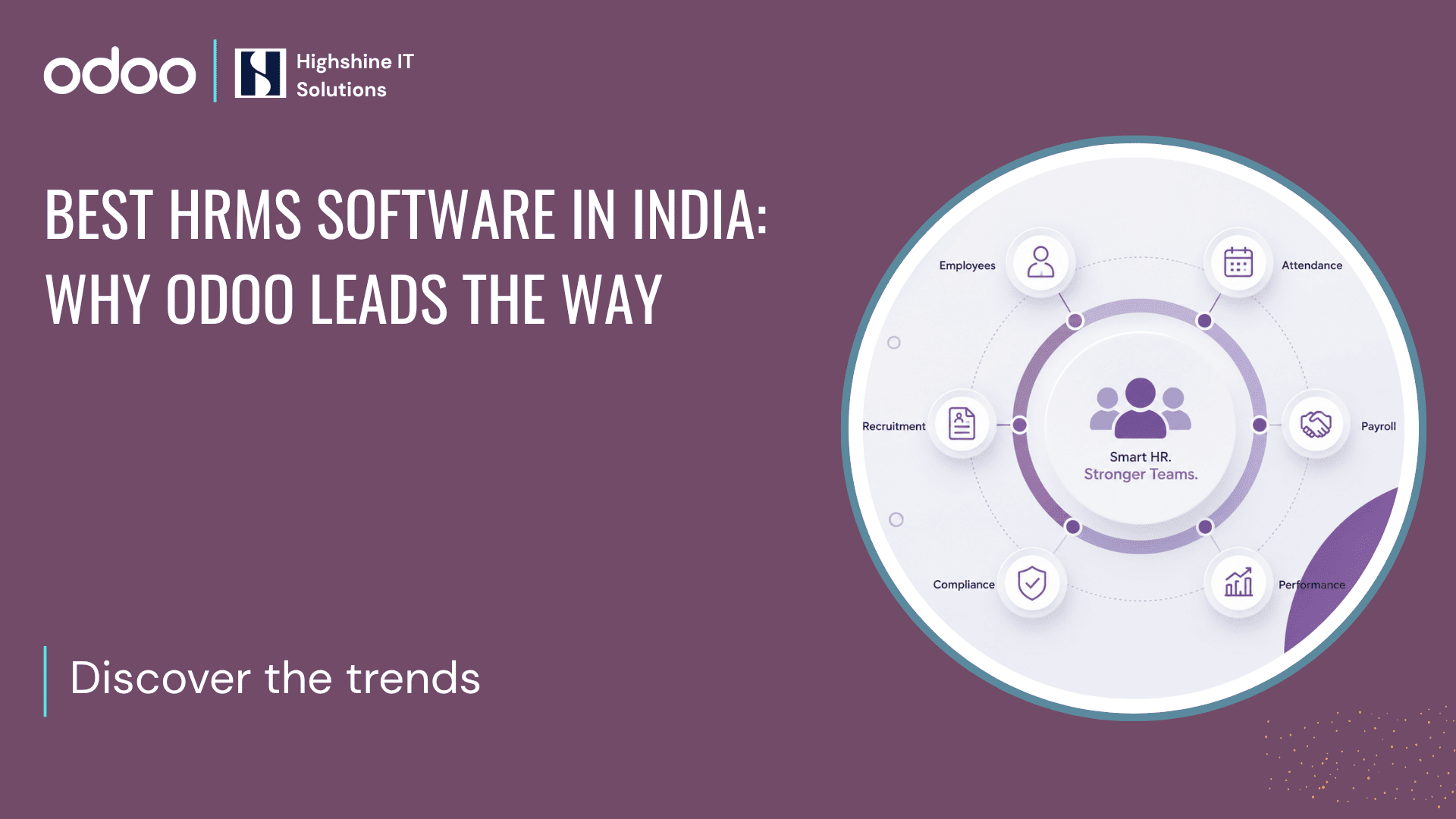
Odoo 19 brought meaningful improvements to the HR modules, making the platform more relevant to the specific compliance and operational needs of businesses in India. Here is a closer look at what each module delivers.
Odoo 19 HR Modules: What Each One Does
Recruitment
Odoo's recruitment module gives hiring teams a visual pipeline where every open position, application, and interview stage is visible at a glance. Job postings can be published directly to your careers page, and applications flow in automatically. Recruiters can schedule interviews, send automated responses, and move candidates through stages without leaving the system. The module connects directly to the Employees module so that once a candidate is hired, their information carries over without re-entry.
Employee Management
The Employees module is the central record for everything related to your workforce. Contract details, personal information, reporting structure, job position, and document storage are all maintained here. HR managers can get a full view of any employee's history, and the information feeds into payroll, leave, and appraisal modules automatically, keeping records consistent across the platform.

Attendance Tracking
Odoo tracks attendance through multiple channels, including manual check-in, kiosk mode, and integration with biometric devices. Managers get real-time visibility into who is present, late, or absent, and attendance data flows directly into payroll calculations. For businesses with multiple locations or remote teams, this flexibility is particularly important.

Leave Management
Leave policies can be configured to match your organization's rules, including leave types, accrual methods, carryover limits, and approval workflows. Employees submit leave requests through the self-service portal, managers approve or reject them with a single click, and balances update automatically. The integration with attendance and payroll means leave deductions are applied accurately without manual calculation.
Payroll Integration
Odoo's payroll module is one of the strongest reasons Indian businesses consider it the best payroll software in India. It supports configurable salary structures that can accommodate basic pay, allowances, deductions, PF, ESI, professional tax, and TDS. Payslips are generated automatically at the end of each cycle, and the system maintains a full audit trail of every payroll run. For businesses that are serious about compliance and accuracy, the native integration between payroll and attendance or leave data eliminates the reconciliation step that causes so many errors in traditional setups.

Appraisals
Odoo's appraisal module lets HR teams schedule regular performance reviews, define rating criteria, and track goals at both the individual and team level. Managers and employees can both contribute to the review, and completed appraisals are stored against the employee record, making it easy to track performance trends over time.
Expenses
Employees can submit expense claims directly through the Odoo mobile app or web portal, attach receipts, and route them for approval in a structured workflow. Approved expenses feed into accounting automatically, removing the need for manual journal entries and speeding up reimbursement cycles.
Fleet
For businesses managing a vehicle fleet for employee travel or operations, Odoo's Fleet module tracks vehicle assignments, fuel costs, maintenance schedules, and usage logs. It connects to the HR module so vehicle allocation is tied directly to employee records.
Timesheets
Timesheets in Odoo allow employees to log hours against specific projects or tasks. This is particularly useful for service businesses, consulting firms, and project-based organizations where accurate time tracking is tied to billing and project profitability. Timesheet data feeds into payroll for overtime calculations and into project management for cost reporting.
AI and Automation in Odoo HR
Odoo 19 introduced meaningful AI-assisted capabilities across the HR modules that go beyond basic workflow automation. Automated email sequences can be triggered at different stages of the hiring pipeline, so candidates receive timely communication without the recruiter manually drafting each message.
In attendance and leave management, automated reminders and escalation rules ensure that approvals do not sit pending for days. Payroll automation handles recurring calculations, including all applicable deductions and contributions, so the monthly payroll run requires minimal manual input. Across the platform, smart nudges, configurable notification rules, and activity automation mean the HR team spends more time on people and less time on administrative follow-up. For growing Indian businesses where HR teams are often lean, this kind of automation makes a measurable difference in daily productivity.
Benefits of Choosing Odoo HR for Indian Businesses
• A single platform for the complete HR lifecycle eliminates the need to manage multiple tools and manually sync data between them.
• Native payroll software integration with accounting reduces the reconciliation work that typically consumes HR and finance teams at month-end.
• Highly configurable pay structures and compliance rules make it suitable for the varied statutory requirements across Indian states.
• Employees can securely access a self-service portal to view and update their personal information, manage leave requests, check attendance, and access HR documents anytime.
• Open-source architecture means the platform can be customized to match specific workflows without waiting for a vendor to release new features.
• Modular pricing means businesses can start with the modules they need and expand as they grow, keeping costs in line with actual usage.
Odoo HR vs Traditional HRMS
Best Odoo HRMS Implementation Partner in India: Highshine IT Solutions
Choosing the right HRMS software is only half the decision. The implementation partner you work with determines whether the system actually fits the way your business operates, or whether you end up adapting your processes to fit the software. Highshine IT Solutions, based in Chennai, is a specialist Odoo implementation partner with over a decade of experience helping Indian businesses deploy and customize Odoo across HR, finance, sales, and operations.
Highshine offers end-to-end Odoo services, from the initial consultation and business process analysis through to configuration, data migration, training, and post-go-live support. The team includes certified Odoo consultants who understand the specific HR compliance requirements of Indian businesses, including PF, ESI, professional tax structures, and multi-state payroll rules. Their tailored approach means the Odoo HR modules are configured to match your actual workflows, not a generic template.
For businesses looking for a structured entry point, Highshine offers two dedicated Odoo packages. BizSprint is designed for startups and smaller businesses that need an affordable, quick-to-deploy solution covering core HR and operational functions. BizElevate is suited for companies with more complex requirements, offering enhanced support, deeper customization, and broader module coverage. Both packages are built around real-world business needs, not a one-size-fits-all feature list.
Whether you are implementing Odoo HR for the first time or migrating from an existing system, Highshine provides the expertise and ongoing support to make the transition smooth.
Conclusion
The search for the best HRMS software in India in 2026 leads most businesses to the same realization: they need more than a standalone payroll tool. They need a connected platform that manages the full HR lifecycle, supports Indian compliance requirements, and gives both HR teams and employees a better day-to-day experience.
Odoo HR delivers all of this within a single, customizable platform. With the improvements brought in Odoo 19, including AI-assisted recruitment, automated payroll workflows, and a self-service portal that genuinely reduces HR admin, it stands out as one of the most complete and cost-effective HRMS software solutions available to Indian businesses today.
Frequently Asked Questions:
1. What is the best HRMS software in India for small businesses?
Odoo HR is one of the strongest choices for Indian SMEs because of its modular pricing, India-compliant payroll, and the ability to scale features as the business grows without switching platforms.
2. Does Odoo support Indian payroll compliance?
Yes. Odoo's payroll module supports configurable salary structures that include PF, ESI, professional tax, TDS, and other statutory deductions applicable in India. Pay structures can be customized to reflect different state-level rules.
3. Is Odoo HR suitable for businesses with multiple locations?
Odoo is well suited to multi-location businesses. Attendance, leave, and payroll can be managed across different offices or sites from a single platform, with role-based access ensuring the right people see the right data.
4. Can employees access their payslips and leave balances themselves?
Yes. The Odoo employee self-service portal gives staff direct access to payslips, leave balances, attendance records, and expense submissions without needing to contact HR for each request.
5. How does Odoo HR compare with standalone payroll software in India?
Standalone payroll software handles salary processing but typically requires manual data input from other systems. Odoo integrates payroll with attendance, leave, timesheets, and accounting natively, which eliminates reconciliation errors and saves significant time each month.
6. What makes Odoo different from other HRMS software companies in India?
Odoo's open-source architecture, modular pricing, and deep integration between HR and other business functions set it apart from most HRMS software companies. It can be configured to match specific business workflows rather than forcing businesses to adapt to fixed system constraints.
7. How long does Odoo HR implementation take?
For a standard Odoo HR deployment covering core modules, implementation typically takes four to eight weeks depending on the scope of customization, data migration requirements, and the number of users. A partner like Highshine provides a clear timeline during the initial consultation.
8. Why should I work with an Odoo implementation partner?
An experienced Odoo partner like Highshine IT Solutions ensures the system is configured correctly for your specific HR processes and Indian compliance requirements from the start, reducing the risk of rework, incorrect payroll setups, or compliance gaps that can arise with self-implementation.


